PRODUCT DESIGN • RESEARCH
Car creation flow
Empowering car dealers to trade more efficiently
Team & my role:
Lead Product Designer working closely with a Junior Designer, Product Manager and engineering team (5 engineers). I owned UX and UI end-to-end, from discovery to delivery.
6% reduction in average car creation time

Problem area
Revamping outdated experience
The car creation flow is the starting point for every vehicle entering the Danish market. Each day, around 800 cars are registered in Bilinfo—amounting to more than 300,000 annually—making this flow a critical touchpoint that must be both efficient and easy to use.
However, dealers reported significant usability challenges in the previous experience. The extra equipment catalogue was outdated, and required fields were difficult to identify, leading to confusion, slower workflows, and increased risk of errors. These issues highlighted a clear need to rethink and improve the overall creation experience.
Process
Objective and Key Results
The team set up objective and Key Results:
Empower car dealers to create high quality car ads in an easy and effective way.
We kicked off the project by first establishing a baseline for the current experience. To do this, we conducted a heuristic evaluation of the existing flow and ran think-aloud usability tests with dealers as they completed real tasks in the old system.
Through studying the process and user behavior, we identified several key pain points and unmet needs in the current experience:
Confusing price fields – Multiple price inputs appear at once, and dealers often try to interact with disabled fields (for example, a down payment must be added before selecting a leasing type), creating frustration and errors.
Outdated extra-equipment catalogue – The catalogue contains missing or inaccurate data and is difficult to navigate. Dealers feel uncertain about selecting the correct equipment and unsure what information buyers actually expect to see.
Offline note-taking during sales conversations – Dealers frequently collect information on paper (such as printing the extra-equipment page) and later transfer it into Bilinfo. This manual step leads to forgotten details and incomplete car records.
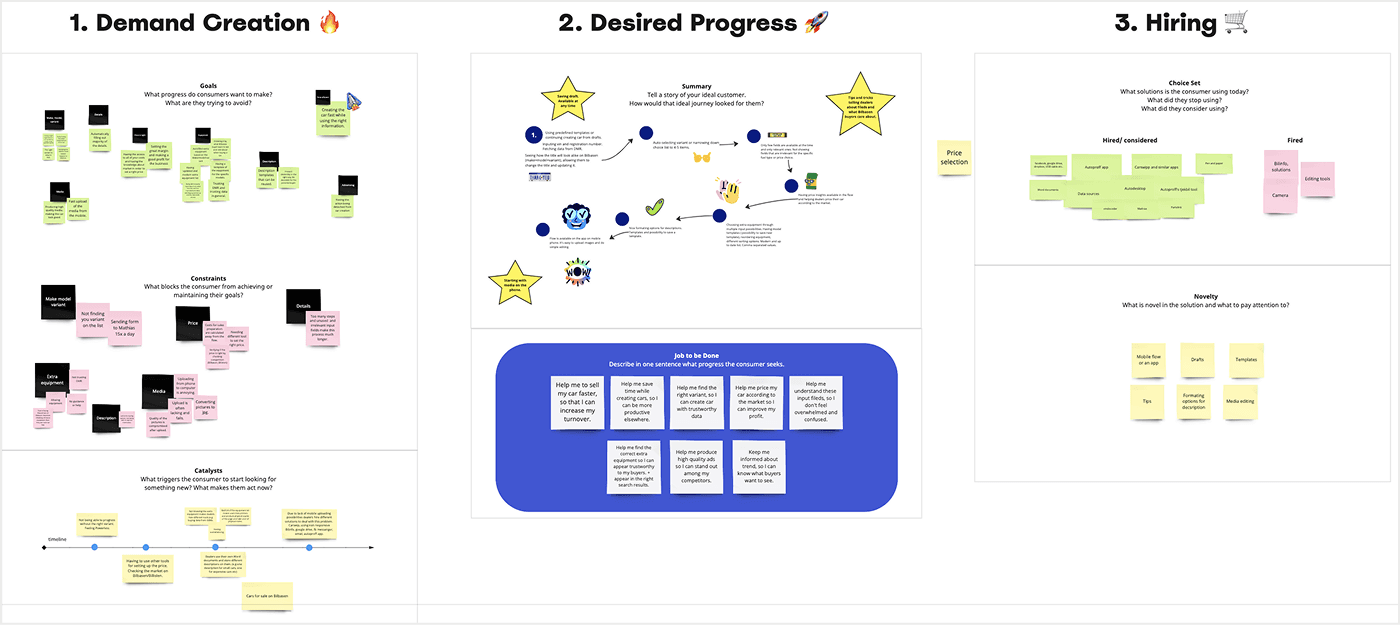
Furthermore, I facilitated a Jobs-to-Be-Done (JTBD) workshop together with the junior product designer and product manager to better understand the underlying motivations behind dealers’ behavior in the Car Creation Flow.
The goal was to move beyond surface-level usability issues and identify the functional, emotional, and social jobs dealers are trying to accomplish when creating a car in Bilinfo.
Core Job Statement
When I finish a customer conversation or prepare a vehicle for sale,
I want to quickly and confidently create a complete and accurate car listing in Bilinfo,
so that the car becomes visible to buyers without errors or follow-up work.
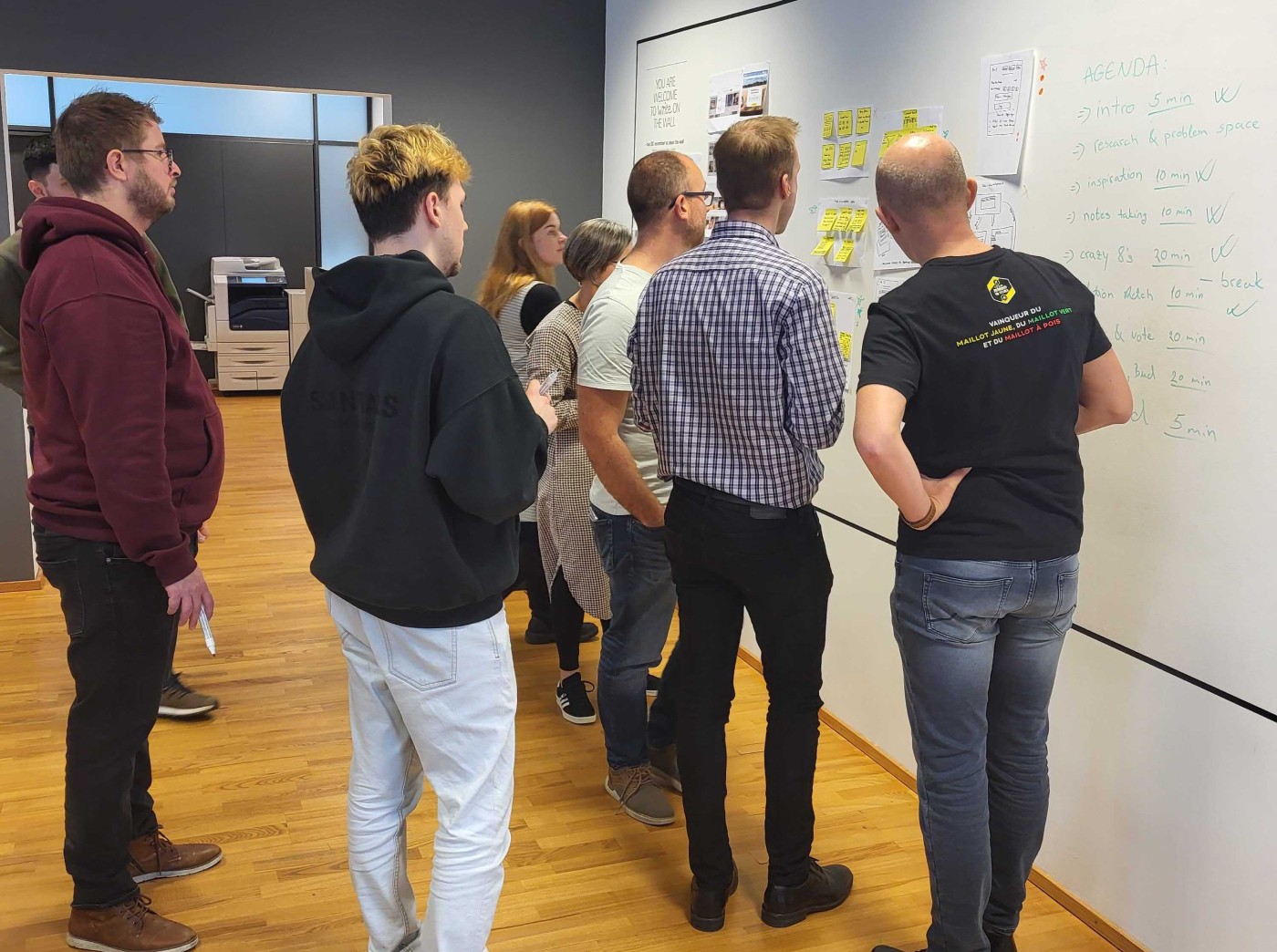
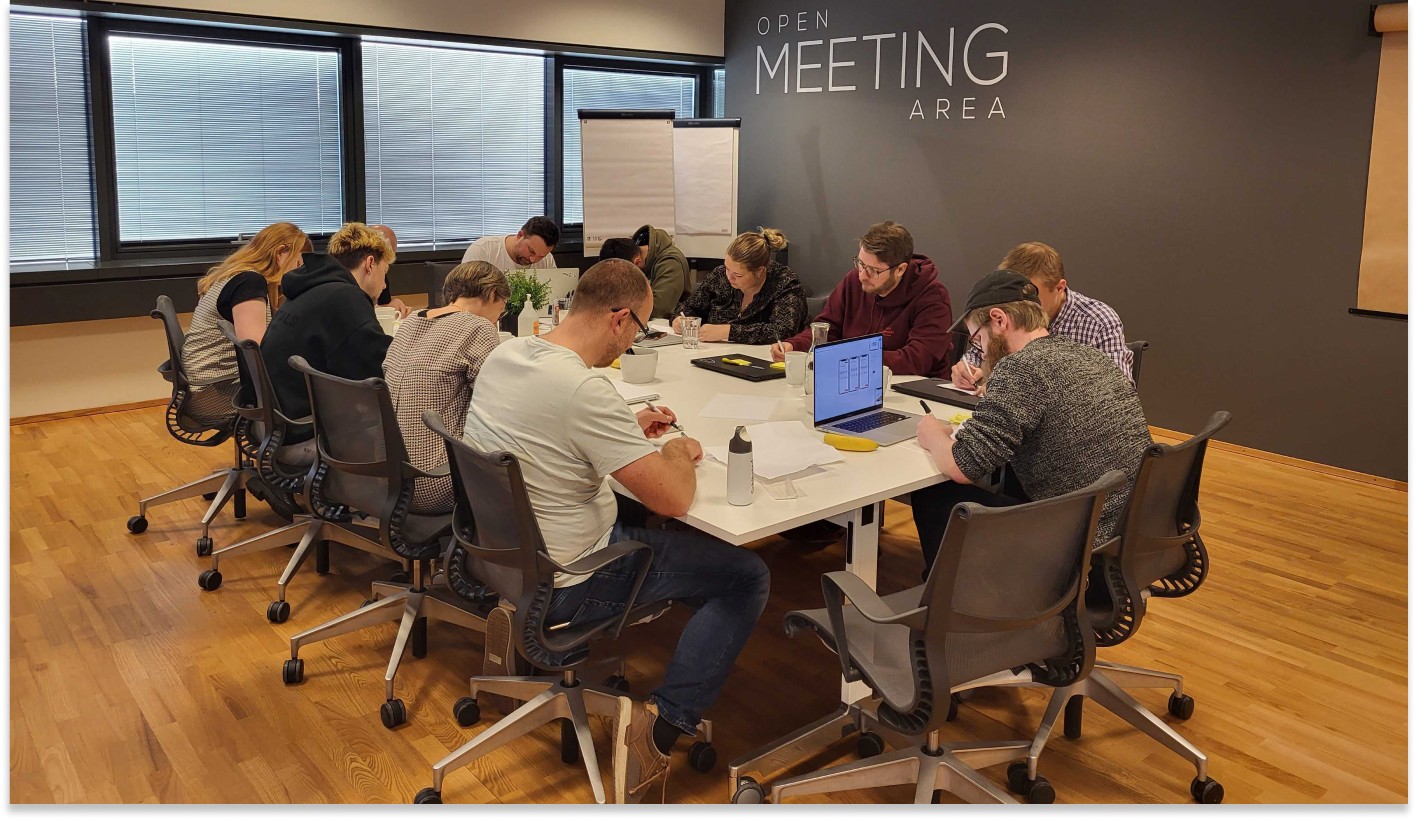
To translate these insights into action, we brought the identified Jobs-to-Be-Done into a collaborative ideation workshop with the full product team and key stakeholders.
The goal of the session was to align on the most important user needs and explore a wide range of creative, yet feasible solution directions that could improve both usability and dealer confidence in the Car Creation Flow.
During the workshop, we:
Reframed JTBD insights into “How Might We” questions to spark solution-oriented thinking.
Generated multiple concepts through rapid sketching and group ideation.
Evaluated ideas based on user value, technical feasibility, and business impact.
Identified a set of promising solution themes to take forward into design exploration.
This collaborative process ensured that the emerging solutions were not only grounded in real dealer needs, but also supported across product, design, and business stakeholders, creating strong alignment before moving into prototyping.
Solution
The new way to create car listings
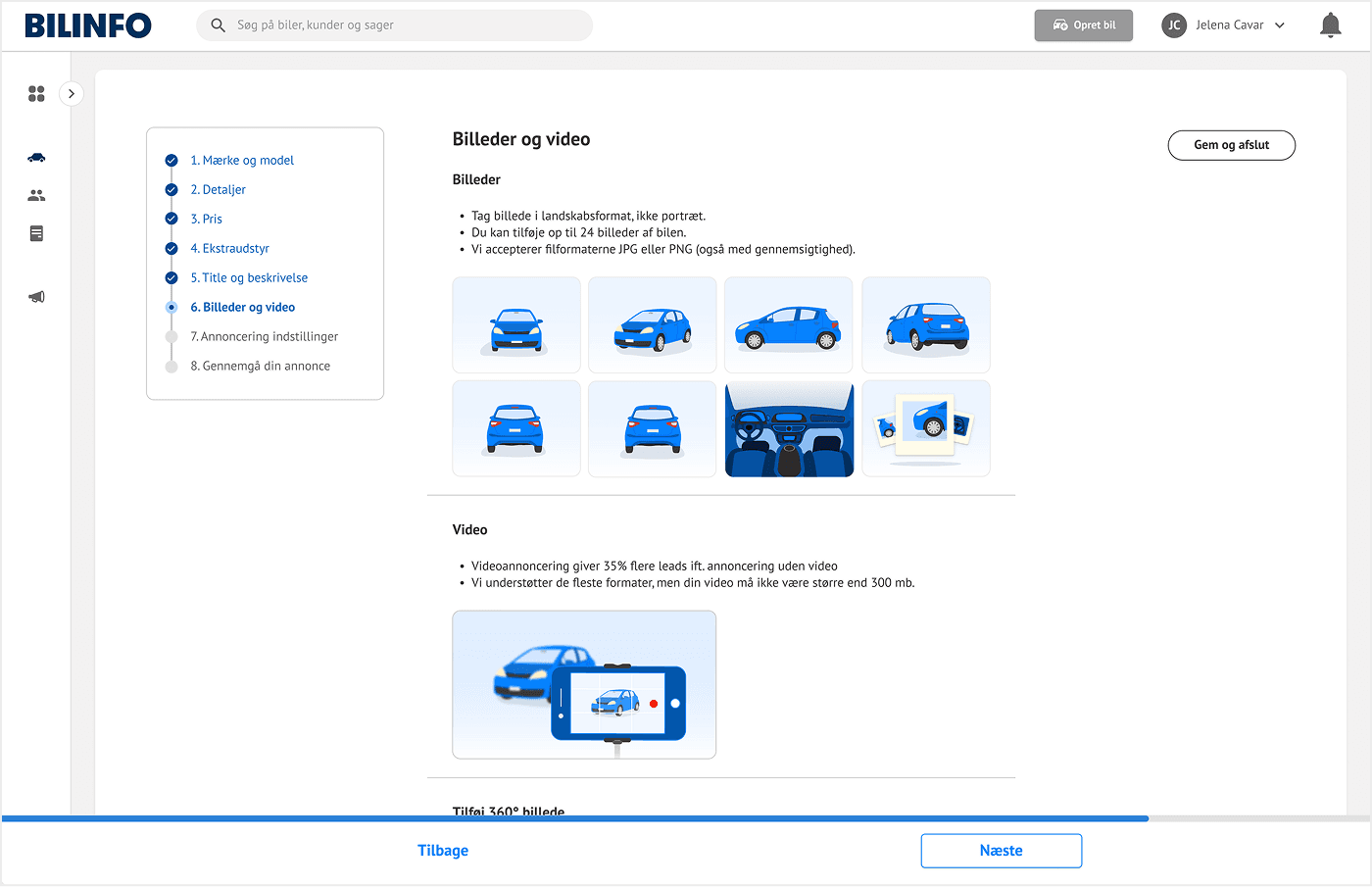
Based on research insights, JTBD mapping, and cross-team ideation, we redesigned the Car Creation Flow to improve clarity, confidence, and efficiency for dealers.
Clear and guided data entry
We introduced well-defined input states across all fields, including clear error messages, validation rules, and required indicators. This made it easier for dealers to understand what information is needed, prevented interaction with unavailable options, and reduced the risk of incomplete or incorrect submissions.
Step-by-step flow structure
The creation process was reorganized into logical, manageable steps rather than a single long form.
Breaking the flow into stages helped dealers focus on one task at a time, improved orientation, and made overall progress more transparent.
Smart data prefill through integrations
To minimize manual work, we implemented multiple data integrations that automatically populate vehicle information whenever possible. Because Bilinfo contains many years of historical car data, there is a high likelihood that a used vehicle being created has previously existed in the system.
We leveraged this by matching cars via registration plate/vehicle identification number, allowing existing data to be reused and significantly reducing input effort.
In addition, we strengthened the integration with the Danish Motor Register, enabling reliable retrieval of official vehicle details and improving overall data accuracy.
Together, these changes transformed the Car Creation Flow into a more guided, automated, and error-resistant experience, helping dealers create complete car listings faster and with greater confidence.
Impact
Impact and reflections
The redesigned Car Creation Flow delivered measurable improvements in both efficiency and user satisfaction.
After launch, we achieved a 6% reduction in average car creation time, helping dealers complete the process faster and with fewer errors. User feedback was also highly positive, with a 4.6 out of 5 satisfaction score collected through an in-product Hotjar survey. Dealers specifically praised the clearer structure, guided input fields, and reduced manual effort.
In terms of our OKRs:
Leading indicators were met: usability tests showed higher task success and clearer input comprehension.
Lagging indicator (reducing average flow time) was partially achieved, but we faced challenges with our second OKR, as creating a high-fidelity prototype was difficult due to complex integrations with historical car data and the Danish Motor Register. Despite this, we were able to validate solutions with users and implement the changes successfully in production.
This project was a strong team win. Many of the solutions implemented originated from ideas generated in the cross-functional ideation workshop, demonstrating the value of collaborative problem-solving. Close alignment between design, product, engineering, and stakeholders ensured that research insights translated efficiently into practical improvements.